
American television has gone through more change in the past fifteen years than in the previous fifty. The living room that once revolved around a single cable box now juggles streaming apps, a game console, a smart speaker, and a remote drawer nobody fully understands anymore. Underneath all that complexity, one technology has quietly become the foundation of where television is actually headed: IPTV.
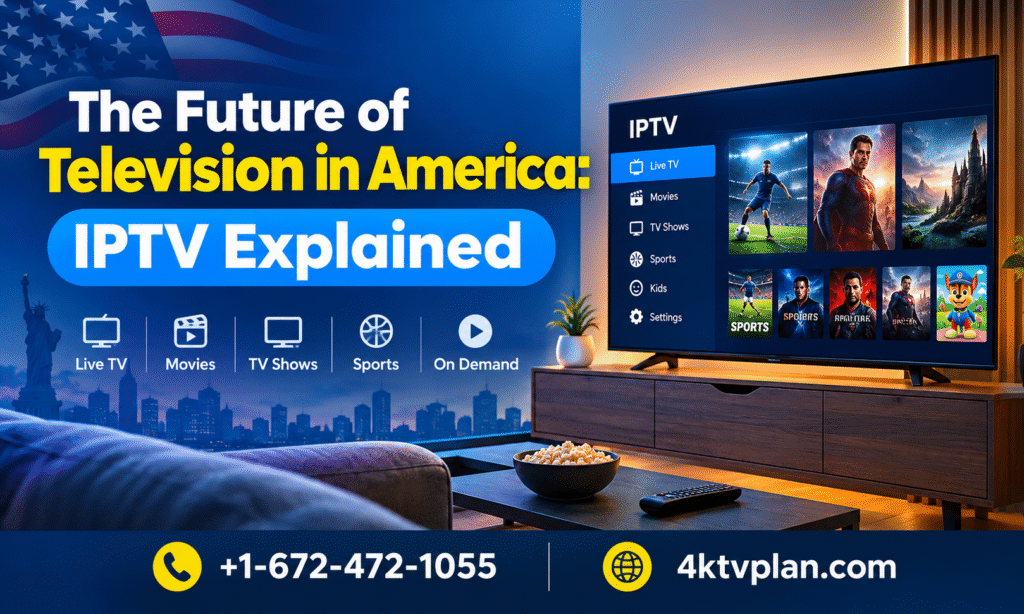
This guide explains exactly what IPTV is, how it’s different from the streaming apps most Americans already use, why it represents a genuine shift rather than just another passing trend, and what it’s likely to mean for how households across the country watch television over the next several years.
None of this requires a technical background to understand. By the end, you’ll have a clear picture of why this particular shift has staying power, and a simple way to try it for yourself without any real commitment.
A Brief History: How America Got Here
Broadcast television started with a handful of over-the-air channels, decided entirely by networks on a fixed schedule. Cable and satellite expanded that lineup dramatically but kept the same basic model: a provider bundles channels, and you pay for the bundle whether or not you watch most of it. For decades, that was simply how television worked, because there was no real alternative.
Then came the streaming era, which solved one problem and created another. On-demand apps gave viewers control over when to watch, but as more of them launched, households ended up juggling several separate subscriptions, several separate apps, and several separate bills just to cover what one cable package used to provide in a single place. Convenience went up, but so did fragmentation.
IPTV is the next correction in that cycle. It keeps the control and flexibility that streaming introduced, while pulling live TV, sports, on-demand content, and international programming back into one consolidated place, delivered entirely over the internet rather than through a dish, a cable line, or a patchwork of separate apps.
Looked at this way, American television has moved through three distinct eras in roughly one lifetime: broadcast scarcity, cable and satellite abundance at a fixed price, and streaming fragmentation. IPTV represents a fourth era, one that tries to keep the best parts of each of the previous three while dropping their biggest drawbacks.
IPTV Explained: What It Actually Is
IPTV stands for Internet Protocol Television. Instead of receiving a broadcast signal through a satellite dish or a coaxial cable, your device requests and receives video data over your regular internet connection, the same way a webpage or a video call works. That single architectural difference is what makes everything else about IPTV possible.
In practice, you install an app on a Smart TV, streaming stick, phone, tablet, or laptop, sign in, and get access to thousands of live channels organized in a familiar programme guide, alongside a large on-demand library of movies and series. There’s no satellite dish to mount, no cable box to rent, and no technician visit required to get started.
How IPTV Is Different From the Streaming Apps You Already Use
This is one of the most common points of confusion, so it’s worth explaining clearly. A typical on-demand streaming app gives you a library of movies and series to watch whenever you want, but it generally doesn’t include live television, a channel guide, or live sports in the way broadcast or cable once did.
IPTV covers both halves at once. It delivers live, scheduled programming the way traditional television always has, organized by channel and time, while also including the full on-demand library in the same app. Rather than choosing between live TV and on-demand convenience, IPTV treats them as two parts of the same subscription.
The Technology Powering the Shift
Underneath the simple app interface, IPTV relies on adaptive streaming, which continuously adjusts video quality to match your available internet speed in real time. When your connection is strong, the picture scales up to full HD or 4K. When it briefly dips, quality scales down smoothly instead of freezing entirely. That single piece of technology is a major reason IPTV tends to feel more dependable in daily use than many viewers expect.
A searchable on-demand library sits alongside a live programme guide in the same interface, so finding something specific doesn’t require scrolling through unrelated categories. None of this is especially exotic technology on its own, but combining it into one coherent, easy-to-use product is what has made the difference for everyday households.
This also explains why switching rarely requires learning a new way of watching television. The remote still works largely the same way, live channels are still organized into a familiar guide, and the screen itself doesn’t change. What changes is everything happening behind that screen — a much larger, more flexible library delivered through infrastructure that’s considerably more modern than a decades-old broadcast standard.
Why This Is the Future, Not Just a Trend
A few structural facts support the idea that this shift is durable rather than temporary. Home internet speeds have improved steadily across nearly every part of the country, removing the biggest technical barrier that once made internet-delivered television unreliable. Smart TVs and streaming devices are now standard in the large majority of American homes, meaning the hardware needed to run IPTV is usually already sitting in the living room.
There’s also a generational shift in expectations. Younger viewers who grew up with on-demand access simply expect control over what they watch and when, and that expectation doesn’t reverse itself as those viewers age into forming their own households. Combined with rising dissatisfaction over traditional cable pricing and fragmented streaming subscriptions, the conditions all point in the same direction rather than suggesting a short-lived fad. Older viewers, meanwhile, often find the transition easier than expected once they see how closely the live-TV experience still resembles what they’re used to.
We’ve examined this shift in detail from a few different angles, including the cable TV problem nobody talks about and can one IPTV service replace your entire TV setup, both of which point to the same underlying conclusion: this isn’t a temporary workaround, it’s a genuine replacement for the old model.
What Changes for American Households
Live television doesn’t disappear under this model, it simply moves to an app, with the same channel-and-guide format households already know. Sports, often the single biggest reason people hesitate to cut cable, are typically included as standard rather than a costly add-on, a shift explored in why sports fans are choosing IPTV in growing numbers.
The consolidation extends to everything else too. As detailed in why viewers want everything in one place, live TV, movies, series, and international channels all sit inside one subscription instead of several. And because every household member can build their own favourites, the growing scale of content doesn’t come at the cost of personal relevance, a point we covered in why personalized entertainment is taking over and again in one screen, hundreds of choices.
International and Cultural Programming Joins the Mainstream
America’s television habits have always been shaped by its diversity, and traditional cable has handled that poorly, typically charging a premium for a thin selection of international channels. Our guide to Indian channels available through IPTV in the USA shows how IPTV folds this kind of programming directly into the standard subscription instead of treating it as an afterthought, which is likely to keep expanding as providers compete on the breadth of their international lineups rather than treating it as a niche upsell.
Predictions: Where American Television Is Headed Next
A few trends seem likely to continue shaping the next several years. Expect channel libraries to keep growing in both size and specificity, covering increasingly niche sports, regional programming, and international content as providers compete on breadth rather than just price. Expect personalization to deepen further, with favourites, recommendations, and household-level customization becoming more central to how people navigate an ever-larger library.
Expect pricing to stay simple and transparent as a competitive advantage, since flat, all-inclusive pricing is one of the clearest ways a provider can distinguish itself from the fee-heavy, promotional-rate structure that defined the cable era. And expect reliability, not just content volume, to become an increasingly important differentiator as more of the country depends on a single internet-delivered service for all of its television.
It’s also reasonable to expect the line between live and on-demand viewing to blur even further. Features like instant replay on live channels and deeper integration between what’s currently airing and what’s available on demand are a natural next step once a platform already controls both halves of the experience within the same app.
How the Shift Looks Across the Country
This is already playing out differently depending on where you look, and we’ve documented it closely in markets including New York City, Los Angeles, Seattle, Illinois, Georgia, Florida, Dallas-Fort Worth, Maryland, Michigan, and New Jersey. For a full national overview, our complete guide to the best IPTV service in the USA breaks down exactly what to look for no matter where you live.
Reliability: The Quiet Advantage Behind the Shift
Picture quality and channel range tend to get the spotlight in conversations about IPTV, but reliability may end up mattering just as much for the long run. Traditional satellite service depends on a clear line of sight to the sky, which means storms, heavy snow, and high winds regularly interrupt the picture at exactly the moments households rely on it most.
Because IPTV runs over an existing internet connection rather than external hardware exposed to the weather, that entire category of disruption effectively disappears. As more of the country depends on a single internet-delivered service for all of its television, this kind of dependability is likely to become one of the clearest ways providers differentiate themselves from each other, rather than channel count alone.
A Realistic Timeline, Not a Sudden Leap
It’s worth being clear-eyed about pace. This shift isn’t happening as one dramatic, overnight event, and it won’t finish overnight either. Adoption varies by region, by generation, and by how comfortable a given household already is with streaming technology. Areas with strong internet infrastructure and younger populations have moved fastest, while some communities will take longer to fully transition.
That gradual pace doesn’t make the shift any less real. Cable itself took years to become the dominant model after it first appeared, and streaming took a similar amount of time to become a default habit rather than a novelty. IPTV is following the same pattern, just compressed into a shorter window because the underlying internet infrastructure was already largely in place when it arrived, rather than needing to be built out from scratch.
What This Future Actually Costs
Despite the expanding content and improving technology, pricing has stayed remarkably simple. A flat monthly rate typically covers everything: live channels, sports, movies, series, and international programming together.
| Plan | Price | Highlights |
| 1 Month | $10 | 10,000+ live channels, all sports & PPV events, multi-device support |
| 3 Months | $30 | Same full access, ideal for testing the shift for yourself |
| 6 Months | $60 | Covers half a year with the same flat, predictable price |
| 12 Months | $110 | Best long-term value for a full year of streaming |
Every plan includes over 10,000 live channels, thousands of 24/7 channels, full sports and pay-per-view coverage, FHD/HD/SD quality options, free ongoing updates, 24/7 support, and multi-connection support. Compare the full breakdown on the subscription page, or see monthly vs long-term IPTV plans to decide which length fits your household.
Getting Started With the Future, Today
You don’t have to wait for this future to arrive, since the technology is already fully available. Browse the subscription plans to pick a length, follow the setup tutorial to get everything running on your device, and check the full channel list to confirm your must-watch channels are included.
You can also visit the homepage for a full overview, read more guides on the blog, or reach our team through the contact page with any questions.
The Bottom Line
The future of television in America isn’t a single flashy new gadget or a dramatic overnight change. It’s a quiet, structural shift already underway: live TV, sports, movies, series, and international programming consolidating into one internet-delivered subscription, built on technology that adapts to real-world conditions rather than breaking under them.
IPTV isn’t a replacement for streaming or a nostalgic throwback to cable. It’s the synthesis of both, built for how American households actually want to watch television now, and increasingly, for how they’ll expect to watch it going forward.
The households already living in that future aren’t waiting around for a dramatic announcement to confirm it’s arrived. They simply opened an app, found everything they wanted in one place, and kept watching — which, in the end, is really the entire point.
Frequently Asked Questions
What does IPTV stand for?
IPTV stands for Internet Protocol Television, meaning television delivered over an internet connection rather than through a satellite dish or cable line.
Is IPTV the same thing as a streaming app like the ones I already use?
Not exactly. Most streaming apps focus only on on-demand movies and series, while a full IPTV service also includes live TV channels organized in a programme guide, alongside the on-demand library.
Do I need special equipment to use IPTV?
No special hardware is required in most cases. A Smart TV, streaming stick, Android device, tablet, or laptop with a stable internet connection is generally enough to get started.
How much internet speed do I need for IPTV?
A stable connection of around 10 Mbps or higher is usually enough for smooth HD and 4K playback on one stream, with more speed recommended for multiple simultaneous viewers.
Will IPTV eventually replace cable entirely in the USA?
Adoption has been accelerating steadily as internet infrastructure improves and more households prioritize flexibility over fixed, contract-based bundles, though the pace varies by region.
How much does an IPTV subscription cost?
Plans typically range from around $10 for a single month up to roughly $110 for a full year, with live TV, sports, movies, series, and international channels included at every level.
Can multiple people in my household stream at the same time?
Many IPTV plans support multiple simultaneous connections, so different family members can stream on separate devices at once, depending on the plan you choose.
Can I try IPTV before committing to a longer plan?
Many providers, including our own, offer a short trial period so you can test picture quality, channel range, and reliability before choosing a longer subscription.
Does switching to IPTV require learning a completely new way to watch TV?
No. Live channels are still organized in a familiar guide and the remote works much the same way, so the main change is a larger, more flexible library rather than a new way of navigating television.
Will severe weather affect my IPTV picture quality?
Since IPTV streams over your internet connection instead of a satellite signal, storms have far less direct effect on picture quality than they do on dish-based television, as long as your internet stays up.