
Drive through Midtown, Decatur, or the suburbs ringing the Perimeter, and you’ll notice something missing from a lot of rooftops: satellite dishes. Atlanta has quietly become one of the fastest cord-cutting cities in the country, with households across the metro area walking away from traditional cable and satellite television in favor of something simpler, cheaper, and better suited to how the city actually lives.
That replacement is IPTV — a smarter, internet-powered way of streaming live TV, sports, movies, and international channels, all from a single app. In this guide, we’ll look at exactly why Atlanta is leading this shift, what’s actually taking cable’s place, and how to make the switch yourself.
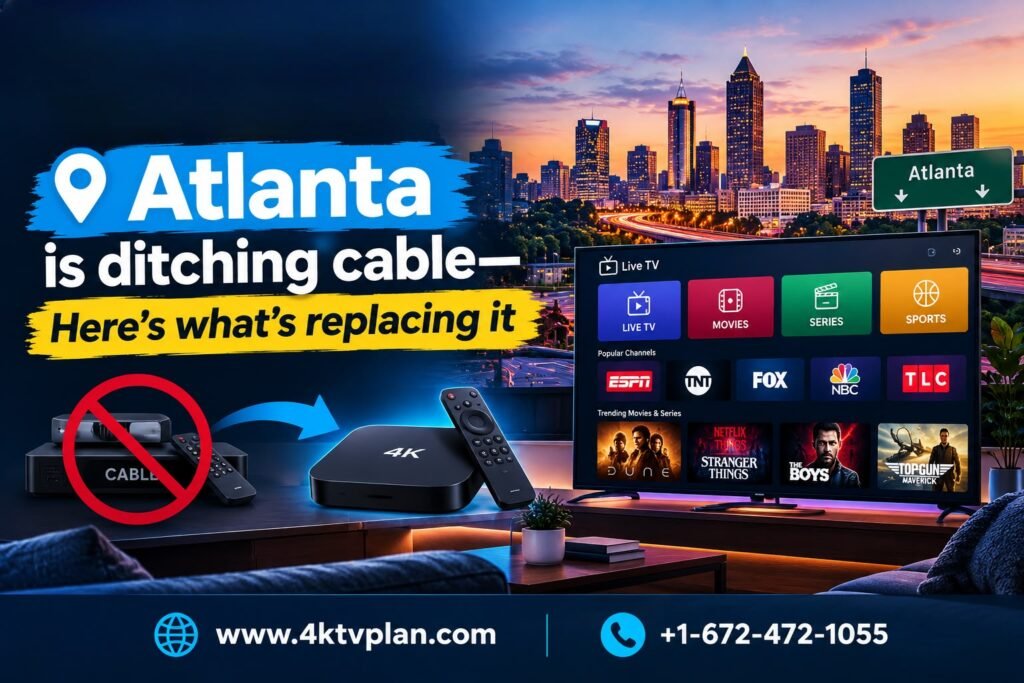
Why Atlanta Is Leading the Cord-Cutting Movement
A few things make Atlanta particularly fertile ground for this shift. The metro area has one of the fastest-growing, most transient populations in the country, with new residents arriving constantly for the city’s booming tech, film, and corporate sectors. Renters and frequent movers make up a huge share of the market, and traditional cable’s installation appointments and long-term contracts have never fit that lifestyle well.
Atlanta’s infamous traffic also plays a role. With some of the longest average commute times in the country, residents want entertainment that fits around unpredictable schedules rather than a fixed broadcast time. On-demand streaming solves that problem directly, letting a missed evening broadcast simply wait until you actually get home.
On top of that, Atlanta is one of the most diverse metro areas in the Southeast, with large international communities who have long been underserved by traditional cable’s limited and expensive international channel add-ons. All of these factors together have made Atlanta a natural early mover in the shift away from cable.
The city’s booming film and television production industry adds one more layer to the picture. A workforce that spends its days immersed in modern streaming and content platforms professionally tends to expect the same flexibility at home, rather than settling for a decades-old broadcast model once the workday ends.
What’s Actually Replacing Cable in Atlanta Homes
IPTV delivers live channels, on-demand movies and series, and sports coverage directly over your internet connection instead of through a satellite dish or cable box. Instead of a fixed regional bundle with a shrinking list of channels people actually watch, a single subscription opens up thousands of live channels alongside a massive on-demand library — all through one app on a Smart TV, phone, tablet, or streaming stick.
There’s no technician visit required, no dish to mount on a roof or balcony, and no long-term contract standing in the way. For a city full of renters and short-term leases, that flexibility alone has been enough to convince a lot of households to make the switch.
It’s also worth noting what doesn’t change in the process. The living room TV stays exactly where it is, the remote still works largely the same way, and live channels are still organized into a familiar guide. The switch isn’t about learning an entirely new way of watching television — it’s about the same screen suddenly having access to a much wider range of content, without the equipment and contracts that used to come attached to it.
The Signs Are Everywhere Once You Look
Beyond the disappearing satellite dishes, there are other visible signs of the shift across the metro. Apartment leasing offices increasingly advertise fiber and high-speed internet as a primary amenity rather than cable hookups. Moving companies report fewer requests to handle bulky satellite equipment. And conversations that once revolved around channel packages have shifted toward comparing streaming apps and internet plans instead.
None of this happened overnight, and it isn’t the result of a single dramatic event. It’s the accumulation of thousands of individual households each deciding, on their own timeline, that the old model no longer made sense for how they actually live. Atlanta simply reached that tipping point earlier than many other metro areas, thanks to the specific mix of renters, commuters, and international communities that make up the city.
What Atlanta Households Actually Get With the New Setup
Thousands of Live Channels, Organized Simply
Live TV doesn’t disappear when you cut cable — it just moves to an app. IPTV keeps the familiar channel-and-guide format while dramatically expanding what’s actually available to browse through.
A Full On-Demand Library
For Atlanta’s shift-working and long-commute households, on-demand access matters just as much as live TV. Movies and full series sit in the same app, ready whenever your schedule actually allows for them, rather than dictated by a fixed broadcast time you may have already missed by the time you’re finally home.
Every Major Sport, One App
Atlanta’s sports calendar runs nearly year-round, and a good IPTV subscription typically includes major leagues, replays, and round-the-clock sports channels, so there’s no need for a separate add-on package just to catch every game throughout the different overlapping seasons.
International Channels Without the Markup
For metro Atlanta’s large international communities, particularly across the northern suburbs, IPTV folds global programming directly into the same subscription instead of treating it as an expensive specialty tier.
Multi-Device Streaming for Every Household
Whether it’s a high-rise unit in Midtown or a family home in the suburbs, IPTV plans typically support multiple simultaneous connections, so everyone in the household can stream on their own device without conflict. That flexibility matters especially for shared apartments and roommate households common across the city’s younger renter population, where several people are often trying to watch different things on different screens at the same time.
Atlanta’s Sports Culture in the New Streaming Era
Sports fans have been some of the fastest to make the switch across the metro, a pattern we explored in depth in the ultimate weekend streaming setup for Georgia families and again in why sports fans are choosing IPTV in growing numbers. Rather than juggling a base cable package plus a separate sports tier, Atlanta households following football, basketball, baseball, and soccer all get everything through the same app, without any extra add-on fees eating into the monthly bill.
College football season in particular has become a major driver of cord-cutting decisions across the metro, since it requires reliable access to out-of-market games that traditional regional cable packages have often struggled to cover consistently. Fans who once needed a specific add-on tier just to catch their alma mater play now find that coverage included as standard.
Which Atlanta Neighborhoods Are Switching Fastest
Cord-cutting hasn’t been evenly spread across the metro — some areas have moved faster than others. Renters in Midtown and Old Fourth Ward have been quick adopters, largely because they don’t want to deal with dish installation in apartment buildings that often restrict it anyway. Buckhead households have leaned toward IPTV for the multi-device flexibility, since many homes there run several TVs and streaming devices at once.
Decatur and East Atlanta have seen strong adoption among younger, tech-comfortable households looking for a straightforward, no-contract alternative. Meanwhile, fast-growing suburbs like Alpharetta, Johns Creek, and Sandy Springs — home to some of the region’s largest South Asian and international communities — have been drawn specifically by the international channel access that traditional cable in the area has never handled well.
Marietta and other suburbs further out along the Perimeter have followed a slightly different pattern, with adoption often driven by cost-conscious families comparing their existing cable bill against a flat-rate alternative and simply doing the math. Once the comparison is laid out side by side, the decision tends to become fairly straightforward for most households.
Atlanta’s International Communities Are Driving Real Change
Few factors have pushed the shift away from cable as strongly as Atlanta’s international population, particularly across the northern suburbs. Our guide to Indian channels available through IPTV in the USA covers exactly this shift — households that once paid a steep premium for a handful of international channels can now access that same programming as a standard part of a single subscription.
This matters especially for multi-generational households, where grandparents often want programming from home while younger family members are more focused on domestic sports and series. Under the old model, satisfying both meant paying for two separate add-ons layered on top of an already expensive base package. Under IPTV, both simply live inside the same subscription.
How This Fits a Bigger National Pattern
Atlanta isn’t cutting cable in isolation — it’s part of a much larger nationwide shift we’ve tracked closely in New York City, Los Angeles, Seattle, Illinois, Florida, Dallas-Fort Worth, Toronto, Winnipeg, and Washington. For the wider national view, our guide to the best IPTV service in the USA breaks down exactly why cord-cutting keeps accelerating city by city.
A Personalized Alternative for Every Household Member
One thing cable never solved is letting different family members actually watch what they want. As explored in why personalized entertainment is taking over, IPTV lets each person build their own favourites list on their own device, which fits Atlanta’s mix of multi-generational households and shared apartments particularly well.
It also means Atlanta households no longer have to juggle several separate subscriptions to cover sports, movies, and series individually — a shift we detailed in why viewers want everything in one place.
What Cutting Cable Actually Costs in Atlanta
The financial case is straightforward once you compare the two side by side. A traditional cable package in the Atlanta area, once you add equipment rental fees, a sports tier, and any international add-on, frequently runs well above what a single flat-rate IPTV subscription costs.
The comparison gets even more noticeable over a full year. A household paying for a base cable package, a sports tier, and a couple of separate streaming subscriptions can easily spend several times more annually than a single IPTV subscription covering all of the same content. Once the equipment rental fees and any price increases after an introductory period are factored in, the gap tends to widen even further.
| Plan | Price | Highlights |
| 1 Month | $10 | 10,000+ live channels, all sports & PPV events, multi-device support |
| 3 Months | $30 | Same full access, ideal for testing the switch across a season |
| 6 Months | $60 | Covers half a year with the same flat, predictable price |
| 12 Months | $110 | Best long-term value for a full year of streaming |
Every plan includes access to over 10,000 live channels, thousands of 24/7 channels, full sports and pay-per-view coverage, FHD/HD/SD quality options, free ongoing updates, 24/7 support, and multi-connection support — no equipment rental fees or hidden surcharges included. You can compare the full breakdown on the subscription page.
Making the Switch: A Simple Starting Checklist
- Check your current cable bill for equipment rental fees and sports add-on charges you’d no longer need
- Browse the channel list to confirm your must-watch local and international channels are included
- Set up the app on your main TV first, then add any additional devices in the house
- Test live sports and on-demand content for a week before cancelling anything else
Running through this quick checklist gives you confidence that the switch actually covers everything your household relies on before you let go of the old setup entirely. Most Atlanta households that follow this approach find the whole process takes far less time than they originally expected.
Getting Started in Atlanta
Switching away from cable takes only a few minutes. Browse the subscription plans to find the option that fits your household, follow the setup tutorial to get everything running on your Smart TV, FireStick, phone, or laptop, and check the full channel list to see exactly what’s included.
You can also visit the homepage for a full overview, browse more city guides and streaming tips on the blog, or reach out through the contact page if you have questions before signing up.
The Bottom Line for Atlanta
Atlanta’s shift away from cable isn’t a temporary trend — it’s a natural response to a city full of renters, long commuters, and diverse international communities who were never well served by a rigid, expensive, contract-bound model in the first place. IPTV steps directly into that gap, offering the same live TV, sports, and on-demand content, alongside international programming, all from a single flexible subscription.
For households still holding onto a dish or a cable box out of habit, the rest of the city has largely already made the decision. The only real question left is when, not if, your own household makes the same switch.
Given how low the cost of testing the switch actually is, there’s very little reason to keep paying for the old setup out of pure inertia. A single month is usually all it takes to see exactly why so many Atlanta neighborhoods have already moved on.
Frequently Asked Questions
Why are so many Atlanta households cutting cable?
Atlanta’s high renter population, long commutes, and large international communities have all pushed households toward more flexible, affordable streaming alternatives that don’t require installation appointments or long-term contracts.
What exactly replaces cable when you switch to IPTV?
IPTV replaces the cable box entirely, delivering live channels, on-demand movies and series, and sports coverage through an app on your Smart TV, phone, tablet, or streaming device instead.
Do I need special equipment to switch in an Atlanta apartment?
No special hardware is required in most cases. A Smart TV, FireStick, Android device, or laptop with a stable internet connection is generally enough to get started, which is especially convenient for apartments that restrict dish installation.
How much internet speed do I need for smooth streaming?
A stable connection of around 10 Mbps or higher is usually enough for smooth HD and 4K playback without buffering, even during live sports broadcasts.
How much does an IPTV subscription cost in Atlanta?
Plans typically range from around $10 for a single month up to roughly $110 for a full year, with live TV, sports, movies, series, and international channels all included in the same flat price.
Can multiple people in my household stream on different devices at once?
Many IPTV plans support multiple simultaneous connections, so different family members can stream on separate devices at the same time, depending on the plan you choose.
Does IPTV include international channels for Atlanta’s diverse communities?
Yes, most full IPTV subscriptions fold international and regional programming directly into the same subscription as domestic channels, rather than charging a separate premium for them.
Can I try IPTV before fully cancelling my cable service?
Many providers, including our own, offer a short trial period so you can confirm channel quality and coverage before deciding to fully cut the cord.
Is IPTV a good fit for renters in Atlanta apartment buildings?
Yes. Since IPTV runs entirely over your internet connection, there’s no dish installation required, which makes it especially convenient for apartment buildings that restrict or prohibit satellite equipment.
Does IPTV work well for households with grandparents watching international channels?
Yes, a full IPTV subscription typically includes international programming alongside domestic content, so different generations in the same household can each find what they want within the same subscription.
